

New Stanton First Review!
Time to Take Your Medicine, Mister Dean

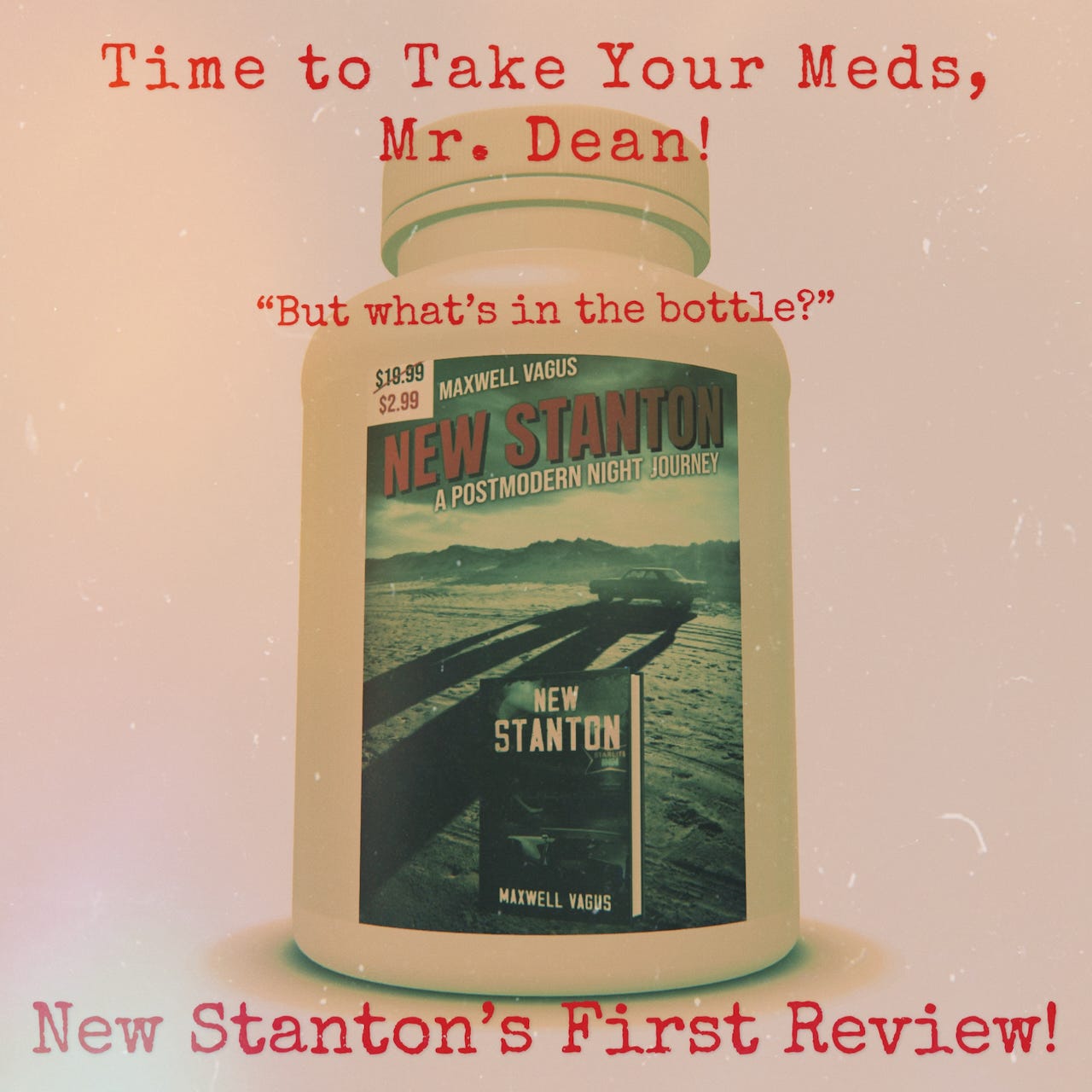
This comes from BookLife. You can read the review there (by clicking on the link) or below. For those of you who have read New Stanton, is it a fair review? For those of you who haven’t, what are you waiting for?
If you’ve read New Stanton, please leave reviews on Amazon and/or B&N and/or Goodreads and/or wherever you can. It would be much appreciated!

This hallucinatory noir debut plunges readers into a roadside purgatory where memory, guilt, and identity blur beneath the green-tinged sky. Beaten up and hung over, Harold Dean awakens in the Starlite Inn, missing his blue 1964 Chevy Malibu and a sizable chunk of his memory. Vagus commences a hard-boiled excavation of addiction, shame, and Harold’s terror of being stranded inside his unstable mind. Looking for answers, Harold explores New Stanton, an irradiated landscape of dead cars, eerie broadcasts, comic-book prophets, and ominous references of “point A to point B.” The strange locals seem to know more about him than he knows about himself.
Vagus has a gift for grimy, neon-lit description and Harold’s swaggering, self-lacerating voice. He’s a very unreliable narrator, whose first-person diatribes are funny and cruel, vivid and wounded. Harold’s recurring “reports” and dream fragments, along with comic/pamphlet motifs, radio transmissions, library/archive material, and vintage car imagery, establish New Stanton as both a physical place and metaphysical trap. The monologues and metaphors can easily become overstuffed, but maximalism is integral to Vagus’s uncanny spell. His heady concoction mixes the existential road novel with a Lynchian small-town nightmare, and he tops it off with a metafictional splash of bitters and remorse.
New Stanton residents, including Mick Curry, comics-obsessed manager of the local print shop, “rockabilly rooster” Robert Tyre, and femme fatale Sonja Freytag, who owns the Starlite Inn (where “cigarettes are on the house”), function more as mythic signals than fully grounded people. Vagus laces Harold’s absurdist encounters with pitch-black humor, and his pacing is intentionally looping and disorienting, resisting clean solutions. Unlike straightforward mysteries, noir emphasizes character over plot and digs into the bleak psyche of its antiheroes. The demanding New Stanton adds cosmic dread to that formula, and Vagus invites devotees to get lost in this surreal odyssey into the abyss.
Takeaway: Immersive vintage noir dials up genre’s existential self-flagellation.
Great for fans of: Jonathan L. Howard’s Carter & Lovecraft, Kobo Abe’s The Ruined Map.
Production grades
Cover: A-
Design and typography: A-
Editing: B+
Marketing copy: A-